

Durable Work Boots for Men: A 2026 Buyer's Guide
Table of Contents
- What Makes a Work Boot Actually Durable
- AS/NZS 2210.3 Safety Standards: What Your Boots Must Meet
- Steel Toe vs Composite Toe Boots: Which Lasts Longer?
- Fit, Comfort, and Long-Term Foot Health
- Work Boot Care and Maintenance Tips
- Sustainability and Eco-Friendly Materials
- How to Choose the Right Durable Work Boots for Your Job
- Frequently Asked Questions
Last Updated: September 23, 2026
What Makes a Work Boot Actually Durable
Durable work boots for men are built from three things: quality leather, a stitched sole that can be repaired, and a midsole that holds its shape under load. Skip any one of those, and you'll be replacing boots every few months instead of every few years.
Material Quality and Construction
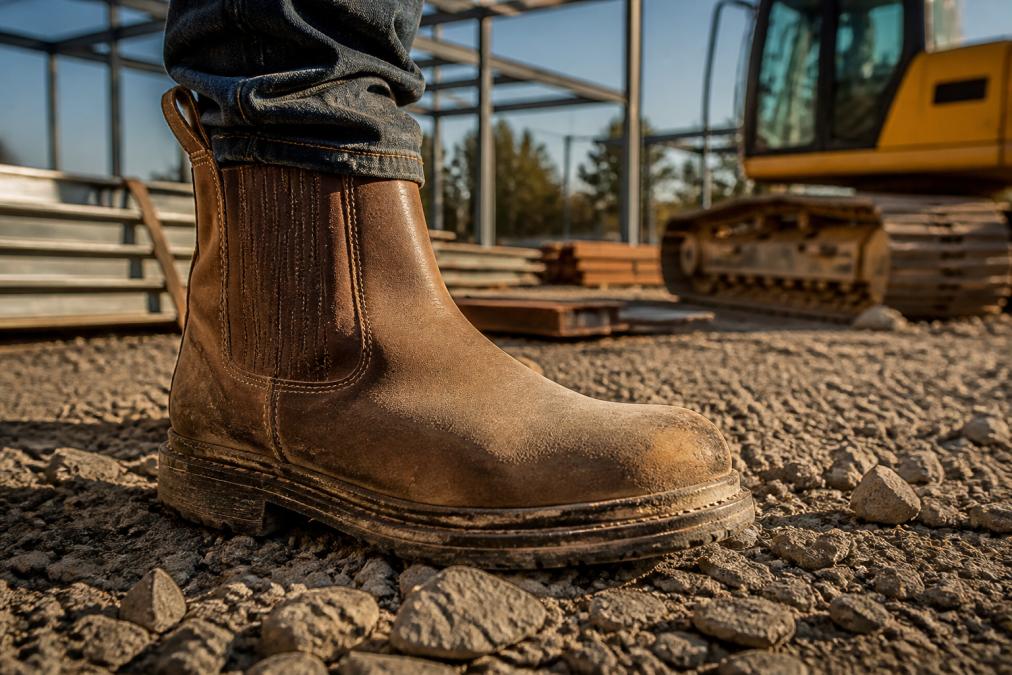
Full-grain leather outlasts corrected-grain and synthetic uppers because it keeps its fibre structure intact. Welt construction, where the upper is stitched to the sole rather than glued, allows resoling and adds years to a boot's life. A common mistake is judging a boot by how it looks new.
Outsole and Midsole Durability
The outsole takes the punishment. Look for a slip-resistant outsole with a heat-resistant sole compound if you're on hot surfaces or in kitchens. A cushioned midsole made from polyurethane or EVA provides shock absorption and foot fatigue relief. When the midsole compresses flat, the boot is done, even if the leather still looks fine. That's the failure point most buyers never see coming.
AS/NZS 2210.3 Safety Standards: What Your Boots Must Meet
AS/NZS 2210.3 is the joint Australian and New Zealand standard that sets the requirements for safety footwear, including impact protection, toe cap performance, and slip resistance. Any boot sold as safety-rated on a worksite should carry a marking that references this standard. The standard is performance-based: it does not tell a manufacturer how to build the boot, only what the finished product must withstand.
Understanding the Markings
The markings tell you exactly what protection you're getting. A steel toe cap or composite toe marking confirms the toe meets the impact threshold. You may also see codes for electrical hazard protection, puncture-resistant midsoles, and metatarsal guard coverage. If a boot has no standard marking, treat it as fashion footwear, not PPE.
Toe Protection vs Penetration Resistance
These are two separate tests and two separate claims, and confusing them is one of the most common buying errors. Toe protection is about impact and compression on the toe cap itself. Penetration resistance is about a plate built into the sole that stops a nail or shard from pushing up through the bottom of the boot.
What the Standard Actually Tests
AS/NZS 2210.3 sets minimum performance for impact resistance, compression resistance, and the integrity of the toe cap under load, along with requirements for the sole's resistance to fuel oil and, where claimed, slip resistance and heat resistance. The test methods are laboratory-based and repeatable, which is why a boot that passes carries a consistent claim regardless of brand.
Slip Resistance Ratings Explained
Slip resistance is often quoted as a rating rather than a pass or fail. Higher ratings indicate better grip on wet or contaminated surfaces, and the rating is measured on specific test surfaces rather than on a generic 'wet floor'. If you work on oily concrete, tiled kitchen floors, or wet clay, a higher slip rating matters more than a heavier toe cap.
Electrical Hazard and Anti-Static Claims
Electrical hazard protection and anti-static properties are separate claims again. Electrical hazard footwear is designed to resist the flow of electricity through the boot under dry conditions, while anti-static footwear is designed to dissipate static build-up rather than block it. They are not interchangeable, and a boot marketed as 'non-conductive' without a standard marking should not be relied on around live circuits.
How to Read a Boot's Marking in the Shop
Turn the boot over and look at the sole and the tongue label. You are looking for the standard reference, the classification code, and any additional claims such as penetration resistance or electrical hazard. If the marking is worn, illegible, or absent, ask for the product specification sheet before you buy.
Steel Toe vs Composite Toe Boots: Which Lasts Longer?
Steel toe boots generally outlast composite toe boots in terms of pure toe cap durability, because steel doesn't fatigue or crack the way composite materials can over years of impact. Composite toe boots win on weight and temperature, since they don't conduct heat or cold and won't set off metal detectors.
| Feature | Steel Toe | Composite Toe |
|---|---|---|
| Weight | Heavier | Lighter |
| Temperature | Conducts heat and cold | Insulates |
| Electrical conductivity | Can conduct | Non-conductive |
| Toe cap longevity | Very high | High |
Weight, Temperature, and Electrical Conductivity
If you work around live circuits, composite toe is the safer choice because it won't conduct. If you work in extreme cold or heat, steel will transfer that temperature straight to your toes. For most general trades, the difference comes down to personal comfort rather than protection, since both meet the same impact standard.
Fit, Comfort, and Long-Term Foot Health
Correct fit is the difference between a boot you can wear for a 10-hour shift and one that leaves you limping. Your heel should lock in place with no lift, and you want roughly a thumb's width between your longest toe and the front of the boot.
The Podiatric Case for Getting Fit Right
Foot fatigue, arch strain, and plantar fasciitis are common complaints among workers who spend long shifts on hard surfaces. A boot that fits well but offers no arch support forces the plantar fascia to work harder with every step, and that load accumulates.
Orthotic Compatibility and Insole Swapping
An orthotic-friendly boot has a removable insole and enough internal depth to take a custom or off-the-shelf orthotic without crushing your toes against the top of the boot. Look for boots described as having a removable footbed, and check that the insole comes out cleanly rather than being glued in place.
Breathability and Moisture Management
A breathable lining and moisture-wicking materials reduce the sweat that breaks down leather from the inside. Moisture is the quiet enemy of durability: it softens the leather, feeds odour, and accelerates lining breakdown at the heel and flex points. If you work in humid conditions or your feet run hot, a breathable lining paired with a moisture-wicking sock will do more for boot life than a heavier leather alone.
Shock Absorption and Ankle Support
A cushioned midsole and padded ankle support cut down on foot fatigue over a long day. The midsole is what absorbs the repeated impact of walking on concrete, and the ankle collar is what keeps your foot stable on uneven ground. Neither is visible in a product photo, which is why they are easy to overlook.
Matching the Boot to Your Foot Shape
Feet differ in width, arch height, and volume, and a boot that suits one worker's foot can be wrong for another's. A high-volume foot needs a roomier boot or a thinner insole; a narrow foot needs a boot that can be laced tight without the upper collapsing.
When to Replace the Insole, Not the Boot
A compressed insole is not a reason to replace a boot with a sound upper and a repairable sole. If the leather is intact and the sole is stitched rather than glued, a new insole and a resole can restore comfort for a fraction of the cost of a new pair.
Work Boot Care and Maintenance Tips
Work boot care and maintenance tips come down to three habits: clean off mud and chemicals, condition the leather, and dry boots properly. Do these and you'll get significantly more life out of any pair.
Cleaning, Conditioning, and Storage
- Brush off dried mud and grit before it works into the stitching
- Wipe down oil, fuel, and chemical splashes with a damp cloth
- Apply leather conditioner every few weeks to stop cracking
- Dry boots at room temperature, never on a heater or radiator
- Store them stuffed with newspaper to hold their shape
Waterproof membrane care is separate from leather care. Rinse the boot, let it dry, and reapply the manufacturer's treatment when water stops beading on the surface. For deeper guidance, the Australian Boot Trade Association care resources covers leather treatment basics.
Sustainability and Eco-Friendly Materials
Sustainability in work boots is finally getting real attention. Look for full-grain leather from tanneries with environmental certification, recycled synthetic uppers, and soles that can be replaced instead of thrown away. Resoling a welt-constructed boot is one of the simplest sustainability wins available, because it keeps the upper in service for years.
How to Choose the Right Durable Work Boots for Your Job
Match the boot to the job, not the other way around. A heavy-duty construction worker needs impact protection, a puncture-resistant midsole, and high abrasion resistance. A farmer or digger needs mud-resistant uppers and a slip-resistant outsole that grips wet ground. Someone working indoors on concrete wants shock absorption and a cushioned midsole to fight fatigue.
Frequently Asked Questions
What are the key features of a durable work boot?
Look for full-grain leather or heavy-duty synthetic uppers, a slip-resistant outsole, a cushioned midsole for shock absorption, and reinforced stitching. A steel toe cap or composite toe provides impact protection. Check for AS/NZS 2210.3 compliance, which confirms the boot meets Australian safety standards. Other features like a waterproof membrane, puncture-resistant midsole, and breathable lining extend the boot's lifespan and keep your feet comfortable during long shifts.
Are steel toe or composite toe boots more durable?
Both steel and composite toe caps meet the same AS/NZS 2210.3 impact resistance requirements, so neither is inherently more durable in terms of protection. Steel toe caps are heavier but can withstand repeated impact without cracking. Composite toe caps are lighter, non-conductive, and resist temperature extremes, but they can crack under extreme pressure. The overall boot durability depends more on the upper material, outsole, and construction than on the toe cap alone.
How do I maintain my work boots to ensure longevity?
Clean mud and dirt off after each use with a stiff brush and lukewarm water. Let them air-dry away from direct heat, then apply a leather conditioner or waterproofing spray every few weeks. Replace laces when they fray, and check the outsole for wear. Store boots in a dry, ventilated area. For zip or slip-on styles, keep the zips clean and lubricated. Regular care can add months to the life of your durable work boots for men.
How often should you replace your work boots?
Replace work boots when the outsole tread is worn smooth, the toe cap is exposed, or the upper has cracks that let water in. For full-time tradespeople, that is typically every 6 to 12 months, depending on the work environment and how well the boots are maintained. If you notice foot fatigue, arch pain, or loss of ankle support, the midsole has likely broken down. Rotating two pairs can extend overall wear.
Choosing durable work boots for men comes down to matching the right construction, safety rating, and fit to the demands of your job. RidgeBackboots builds footwear for exactly that purpose, with the Chippy Slip On for fast on-and-off and the Digger Zip Boot for rugged reliability, both made for people who need boots that hold up. Get started with RidgeBackboots and find the pair that keeps you protected and comfortable through every shift.